- First_Hand_Restoration
Restoration Finishing Detroit: Why Skipping It Leads to Future Repair Costs
Restoration finishing Detroit property owners often treat as an afterthought once structural repairs wrap up — but this final stage is exactly where long-term problems tend to start. When restoration finishing work is rushed, reduced, or treated as cosmetic rather than technical, unresolved issues remain embedded in walls, floors, and surfaces.
Restoration Finishing Is a Technical Process, Not a Cosmetic Add-On
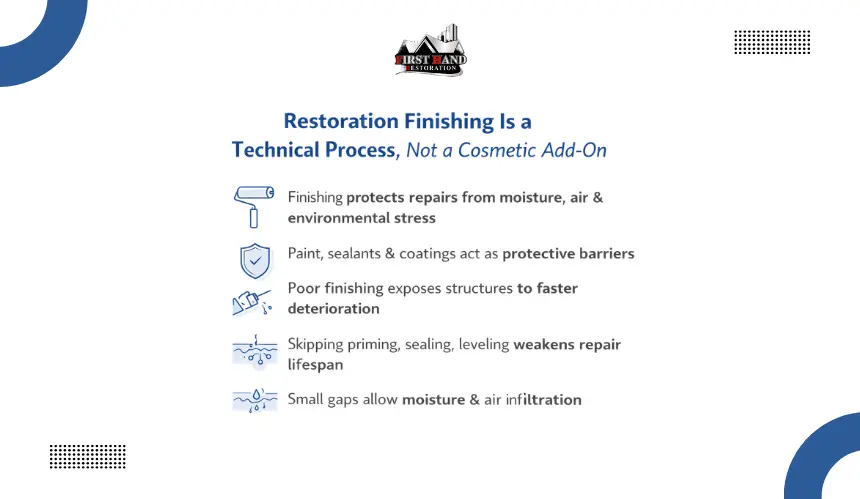
Finishing is often misunderstood as purely visual, but in restoration contexts it plays a critical role in sealing, protecting, and stabilizing repaired areas.
These hidden deficiencies may not appear immediately, but they gradually surface as cracking, moisture intrusion, system inefficiencies, and repeated repair expenses that far exceed the cost of proper restoration finishing the first time around
Paint systems, sealants, trim interfaces, and surface coatings serve as protective layers that regulate moisture movement, air exchange, and surface durability. When these materials are improperly selected or applied, repaired structures remain exposed to humidity, temperature fluctuation, and environmental stress that accelerates deterioration beneath finished surfaces.
Restoration Finishing Is a Technical Process, Not a Cosmetic Add-On
Finishing is often misunderstood as purely visual, but in restoration contexts it plays a critical role in sealing, protecting, and stabilizing repaired areas. This is a core part of what separates true restoration finishing Detroit work from a standard cosmetic touch-up.
Finishing Materials Act as Protective Barriers
Paint systems, sealants, trim interfaces, and surface coatings serve as protective layers that regulate moisture movement, air exchange, and surface durability. When these materials are improperly selected or applied, repaired structures remain exposed to humidity, temperature fluctuation, and environmental stress that accelerates deterioration beneath finished surfaces.
Incomplete Finishing Leaves Repairs Vulnerable
Skipping finishing steps such as proper priming, joint sealing, or surface leveling allows minor imperfections to evolve into structural issues. Small gaps, uneven transitions, or unsealed edges can admit moisture and air infiltration, undermining the integrity of underlying repairs and shortening their effective lifespan.
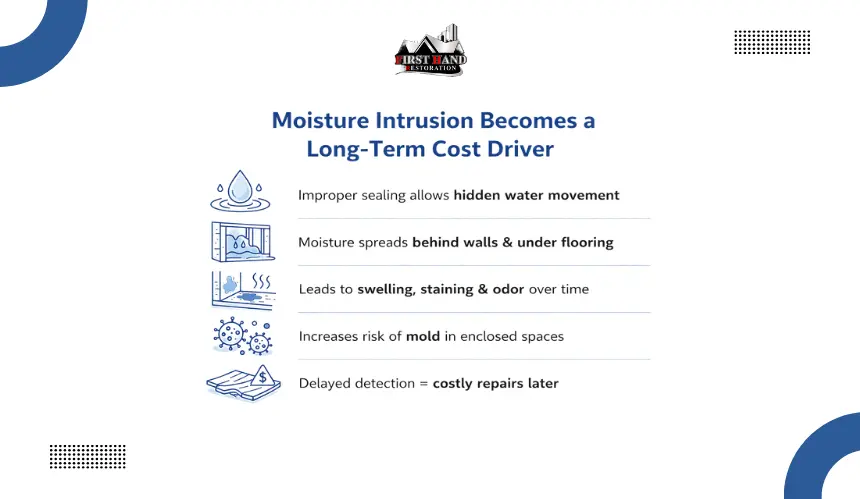
Moisture Intrusion Becomes a Long-Term Cost Driver
One of the most common consequences of inadequate finishing is uncontrolled moisture movement within the building envelope. This is where poor restoration finishing decisions turn into the most expensive repeat repairs
Improper Sealing Enables Hidden Water Migration
When finishing details fail to fully seal repaired areas, moisture can travel behind walls, under flooring, or along framing interfaces. This movement may go unnoticed until swelling, staining, or odor develops, at which point remediation becomes significantly more invasive and expensive than proper finishing would have been initially.
Mold Risk Increases When Finishes Are Incomplete
Moisture combined with organic materials creates favorable conditions for microbial growth. Inadequate finishing allows humidity to linger within wall cavities and surface layers, increasing the likelihood of mold development that requires specialized remediation and disrupts occupancy long after restoration is assumed complete. Restoration and remediation professionals follow standards such as the IICRC’s water damage restoration guidelines specifically because incomplete drying and finishing are among the leading causes of preventable mold claims.
Structural Repairs Depend on Proper Finish Integration
Structural work and finishing are interconnected processes rather than separate phases that can be treated independently.
Movement and Stress Must Be Accommodated
Mechanical systems pass through walls, ceilings, and floors that rely on proper finishing to remain protected and functional.
Improper Penetration Sealing Causes System Degradation
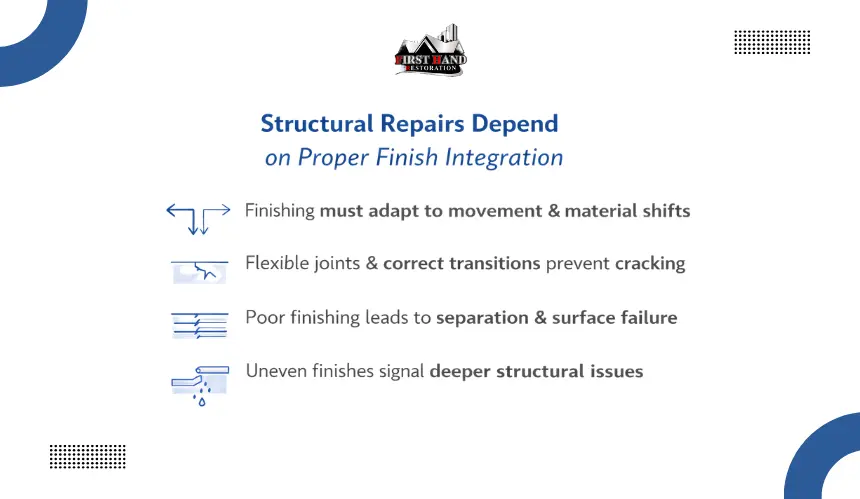
Restored framing and substrates often experience minor movement as materials acclimate. Proper finishing accounts for this movement through flexible joints, correct material transitions, and compatible coatings. When these considerations are ignored, cracking, separation, and surface failure occur prematurely.
Misaligned Finishes Reveal Structural Weaknesses
Uneven surfaces, misaligned trim, or inconsistent textures often indicate deeper issues such as incomplete substrate preparation or unresolved structural irregularities. These visible defects typically signal that underlying repairs were not fully stabilized or integrated, leading to future corrective work.
Electrical, Plumbing, and HVAC Systems Are Affected by Poor Finishing
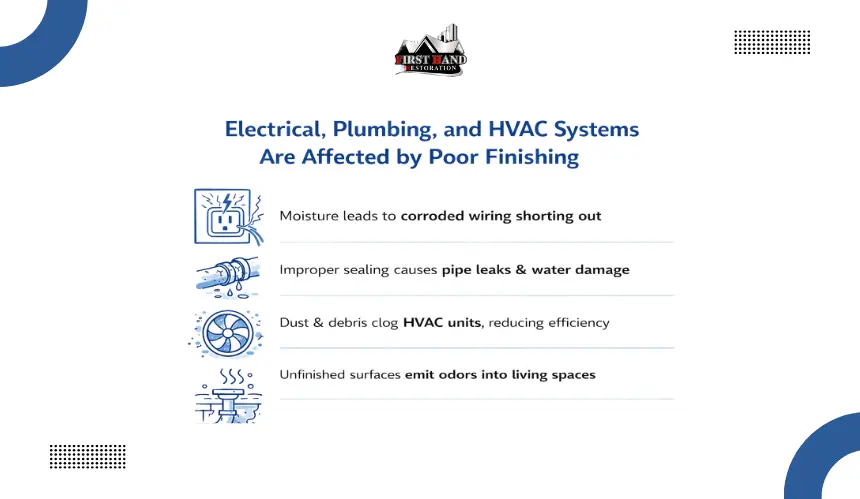
Mechanical systems pass through walls, ceilings, and floors that rely on proper finishing to remain protected and functional.
Improper Penetration Sealing Causes System Degradation
Unsealed or poorly finished penetrations around pipes, wiring, and ductwork allow air leakage, moisture entry, and temperature imbalance. Over time, these conditions accelerate corrosion, insulation breakdown, and system inefficiency that increase operational costs and maintenance frequency.
Access and Serviceability Are Often Compromised
Finishing that ignores access requirements can obstruct service panels, junctions, and valves. When future maintenance becomes difficult or destructive, routine system servicing turns into costly demolition and repair, all stemming from inadequate planning during finishing stages.
Aesthetic Degradation Signals Deeper Performance Issues
Visible finish failures are rarely isolated cosmetic problems; they often reflect underlying performance deficiencies.
Premature Wear Indicates Material Incompatibility
Peeling paint, warped flooring, or separating trim often results from using finishes that are incompatible with restored substrates or environmental conditions. These failures typically repeat unless the finishing approach is corrected, leading to recurring expenses rather than one-time fixes.
Visual Defects Reduce Property Value Over Time
Consistent finish issues diminish perceived quality and can negatively affect resale or rental value. Prospective buyers and inspectors often interpret poor finishes as indicators of rushed or incomplete restoration, raising concerns about hidden defects that impact valuation
Insurance and Documentation Complications Can Arise Later
Inadequate finishing can complicate future claims and documentation long after the original restoration is close
Incomplete Finishing Weakens Claim Justification
When follow-up damage occurs, insurers may question whether failures result from the original event or from substandard finishing. Lack of documented completion and quality control increases the likelihood of disputes and denied coverage for subsequent repairs. The Insurance Information Institute’s guidance on filing homeowners claims underscores just how heavily insurers weigh documentation quality when evaluating repeat or follow-up claims.
Repeated Repairs Increase Administrative and Financial Burden
Each additional repair cycle introduces new inspections, approvals, and costs. Proper finishing reduces the likelihood of reopening claims or absorbing out-of-pocket expenses caused by preventable deterioration
Why Cutting Corners Appears Cost-Effective but Isn't
Short-term budget decisions often drive finishing shortcuts, yet these savings rarely persist
Deferred Costs Compound Over Time
Minor savings achieved by skipping finishing steps often lead to larger repairs involving demolition, remediation, and reinstallation. The cumulative cost of repeated interventions quickly exceeds the original finishing expense.
Occupant Disruption Adds Indirect Costs
Repeated repairs disrupt daily life, business operations, or rental occupancy. Lost productivity, temporary relocation, and inconvenience represent indirect costs that are rarely considered upfront but significantly impact long-term outcomes.
Addressing these signs promptly often allows targeted correction before widespread damage occurs. Delayed response typically expands the scope and cost of necessary repairs.
Frequently Asked Questions
Yes. Restoration finishing must integrate with repaired structures and systems rather than purely aesthetic upgrades.
Yes. Improper finishes can expose repairs to moisture, movement, and environmental stress.
Because moisture migration, material movement, and chemical reactions develop gradually over time.
Yes. Documented, complete finishing supports clearer claim history and reduces disputes.
Generally no. Finishing shortcuts often create hidden vulnerabilities that lead to higher long-term costs.
Finishing as the Final Line of Protection
Skipping proper restoration finishing leads to future repair costs because it leaves repaired structures exposed, systems vulnerable, and materials incompatible with long-term environmental conditions. Finishing is the final line of defense that stabilizes repairs, controls moisture, and preserves performance across the entire property.
When executed thoroughly and correctly, it prevents repeated interventions and protects investment value. Property owners seeking durable outcomes often rely on experienced providers such as First Hand Restoration Service LLC to ensure finishing is treated as a critical technical phase rather than an optional aesthetic step.